Testagen appears in peptide catalogs as a short synthetic peptide usually identified as KEDG. The strongest recurring data points are its four-residue sequence, its place in ultrashort-peptide literature, and a small set of papers that discuss cell entry, DNA interaction, histone binding, transporter modeling, and cell differentiation.
For many readers, the first question is simple: what is testagenResearch-oriented sources typically describe testagen as the tetrapeptide H-Lys-Glu-Asp-Gly-OH, often shortened to KEDG or H-KEDG-OH; product pages then add catalog fields such as purity, formula, molecular weight, and storage notes.
However, the name creates confusion. Searchers often mix up testagen with testosterone because the terms look similar. In contrast, the available literature and supplier listings describe testagen as a peptide, while testosterone is a steroid hormone. That distinction matters because a careful testagen page should stay focused on chemistry, research context, and documentation rather than drift into broad hormone language.
What Is Testagen?
Testagen as KEDG
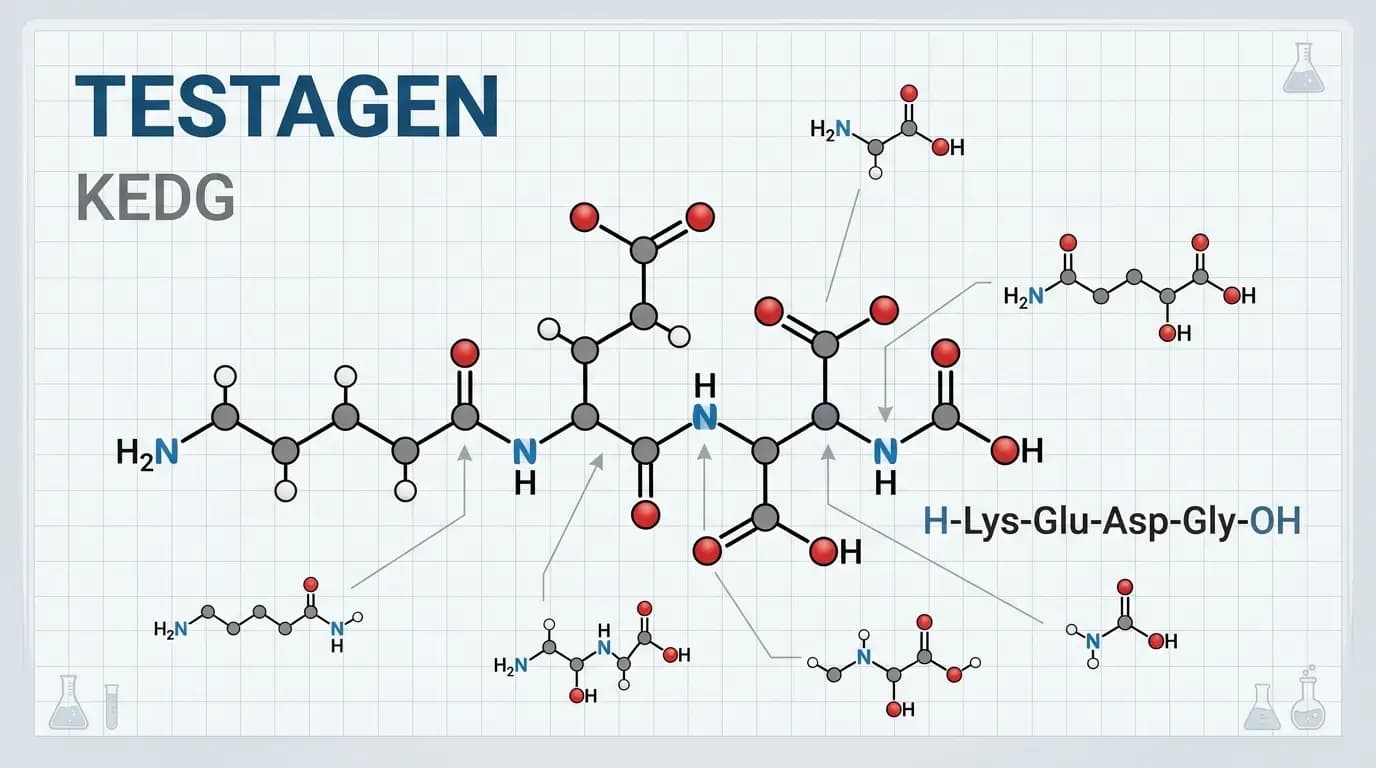
Testagen is most commonly presented as KEDG, a tetrapeptide built from lysine, glutamic acid, aspartic acid, and glycine. Supplier pages and review literature align on that core identity, which is why sequence-level verification is the first useful checkpoint when evaluating any testagen listing.
Testagen and testosterone are not the same
Testagen is not the same substance as testosterone. Literature and catalogs present Testagen as a short peptide, whereas testosterone belongs to a different chemical class. Therefore, a research page about testagen should answer the comparison clearly and then return to peptide-specific evidence.
Why the name creates confusion
The confusion comes from naming, not from chemical identity. Some commercial pages lean heavily on endocrine wording, and that can make a new reader assume that testagen is simply another name for testosterone. Yet the sources that actually describe KEDG at sequence level point back to peptide chemistry, chromatin-related interaction studies, and ultrashort-peptide frameworks.
Testagen Structure and Core Specifications
Sequence, length, formula, and molecular weight
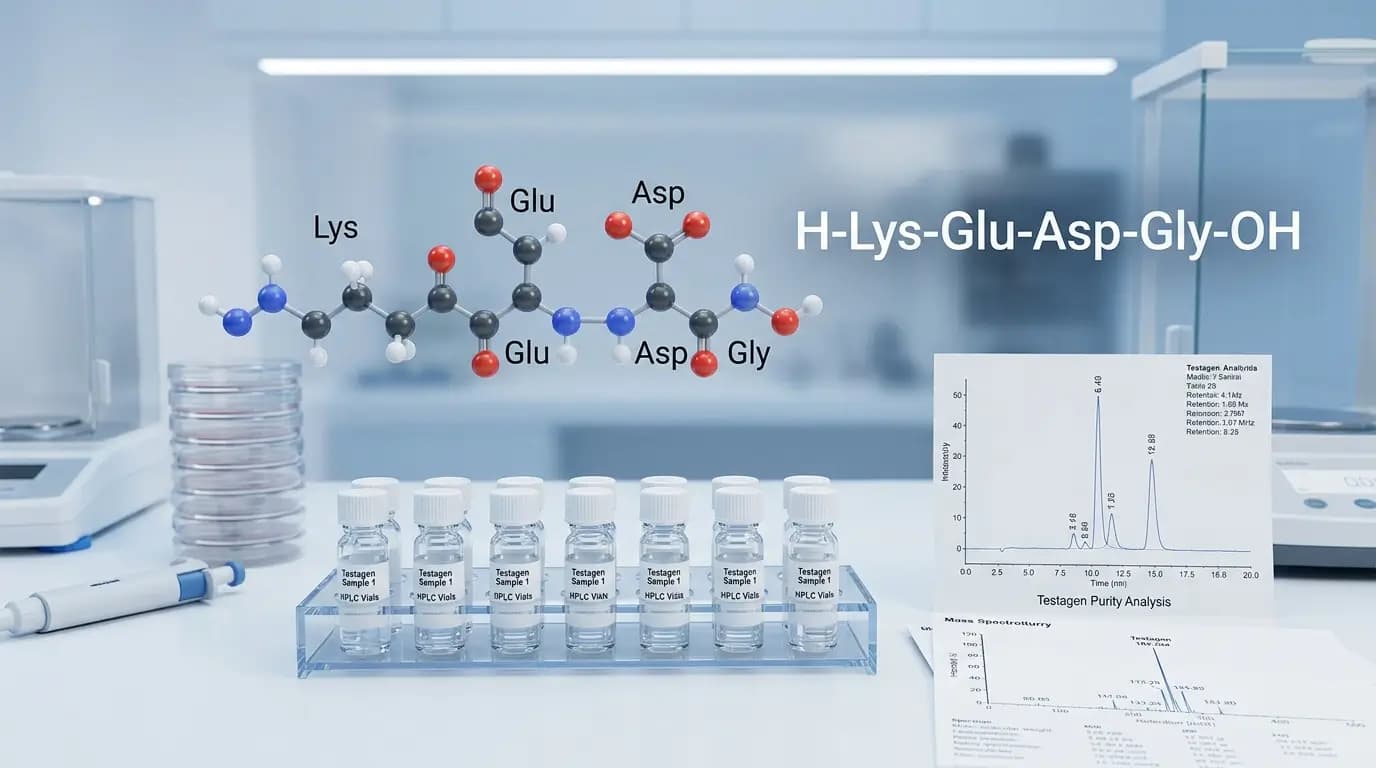
Across the cleaner catalog-style sources, testagen is listed with the sequence H-Lys-Glu-Asp-Gly-OH, a peptide length of 4 amino acid residues, molecular formula C17H29N5O9, and molecular weight 447.44. Those identifiers give researchers a concrete base for checking whether a product page is internally consistent.
Common catalog identifiers for testagen are summarized below.
Identifier | Commonly listed testagen data |
|---|---|
Name | Testagen |
Short name | KEDG or H-KEDG-OH |
Sequence | H-Lys-Glu-Asp-Gly-OH |
Length | 4 amino acids |
Formula | C17H29N5O9 |
Molecular weight | 447.44 |
Form | Synthetic peptide, often lyophilized powder |
Storage | Commonly listed at or below -20 °C |
Why these identifiers matter
A testagen page without clear sequence and analytical data gives very little to work with. By comparison, a stronger page places the sequence, peptide length, formula, molecular weight, and batch-level documents near the top. Moreover, these fields help readers separate actual catalog information from broad descriptive copy.
Why sequence matters more than headline copy
Headlines on peptide pages can vary widely, but sequence usually tells the more stable story. For example, a page may frame testagen in one research context, while another page frames the same sequence in a different one. Because of that, researchers often start with the sequence, then move to purity documents, then to the cited papers.
Where Testagen Fits in Ultrashort Peptide Research
Testagen among 2 to 7 residue peptides
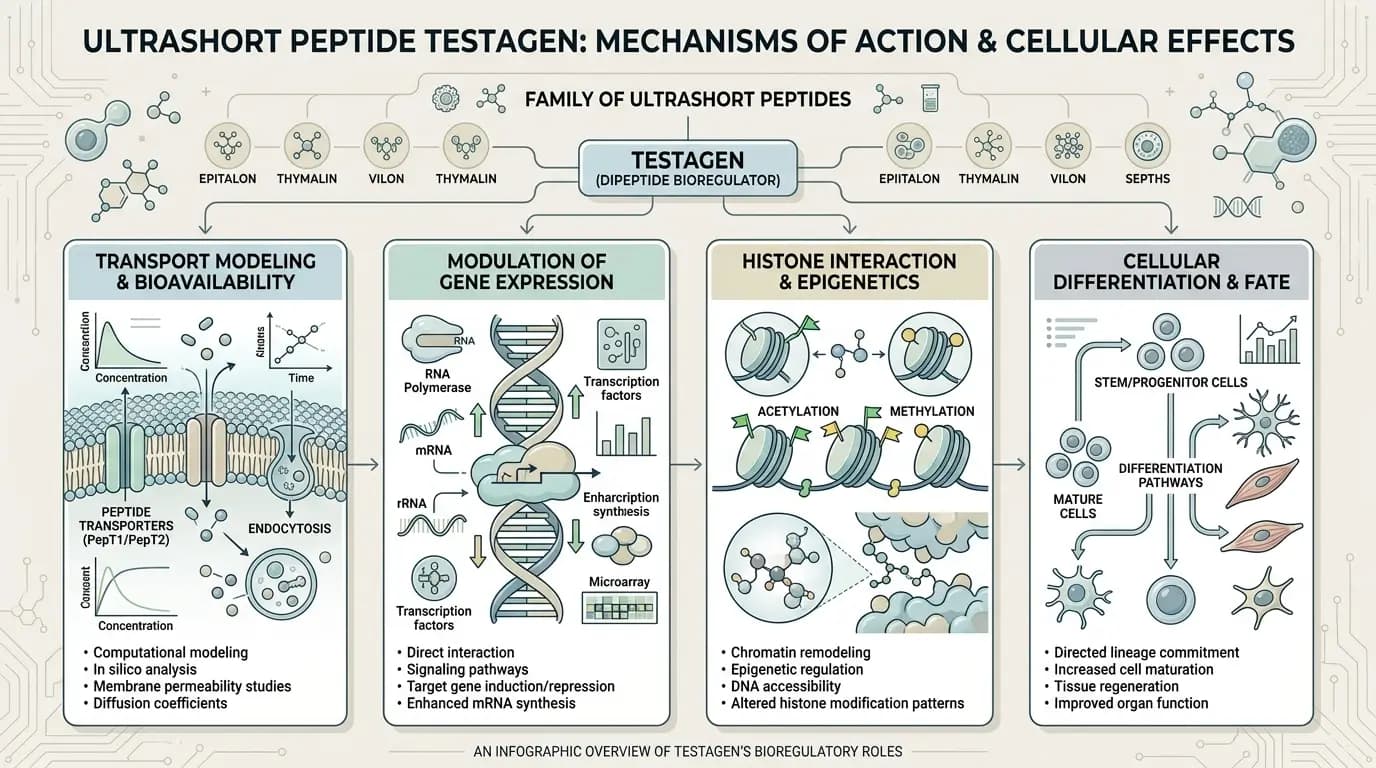
Testagen is usually discussed within the broader literature on ultrashort peptides. A 2021 systematic review describes short peptides as molecules of 2 to 7 residues that can interact with nucleosomes, histones, and DNA, and it places KEDG within that broader framework rather than treating testagen as a stand-alone field with a large, independent evidence base.
Testagen in gene-expression reviews
That same review maps KEDG into discussions of peptide regulation of gene expression. Specifically, it notes KEDG among peptides reported to bind histone proteins and to appear in differentiation-related discussions. Consequently, testagen is often presented less as a single isolated discovery and more as one member of a recurring short-peptide research cluster.
Testagen in transporter modeling
A 2023 Biomolecules paper adds another layer by modeling transport of 26 biologically active ultrashort peptides through LAT1, LAT2, and PEPT1. In that analysis, KEDG appears among peptides with higher predicted binding scores than many comparison dipeptides and tripeptides. That does not settle every mechanistic question, but it does show why transporter language appears in discussions of testagen.
How Testagen Is Studied at the Molecular Level
Cell and nuclear localization
One of the most frequently cited observations in this area comes from fluorescence-labeling work. A 2011 paper reported that researchers observed labeled testagen, alongside other short peptides, in the cytoplasm, nucleus, and nucleolus of HeLa cells. In other words, testagen entered the cellular spaces that many mechanism-focused papers discuss.
DNA and histone interaction
A second recurring theme is chromatin-related interaction. The 2021 systematic review states that KEDG is among short peptides reported to bind histone proteins H1, H2B, H3, and H4, and a 2013 paper suggested that site-specific interaction of short peptides with histone tails could act as an epigenetic control mechanism for gene activity and cellular differentiation.
What “mechanism” means for testagen
When a product page says researchers studied testagen for gene expression, that phrase usually points back to the kinds of findings above: cellular localization, histone association, DNA interaction, and transporter modeling. It does not automatically mean that the literature has fully mapped every downstream pathway for testagen itself. Therefore, the most accurate reading is that testagen sits inside a mechanistic research zone that is still narrower than much of the sales language built around it.
Research Areas That Mention Testagen
Cell differentiation and immune-lineage discussions
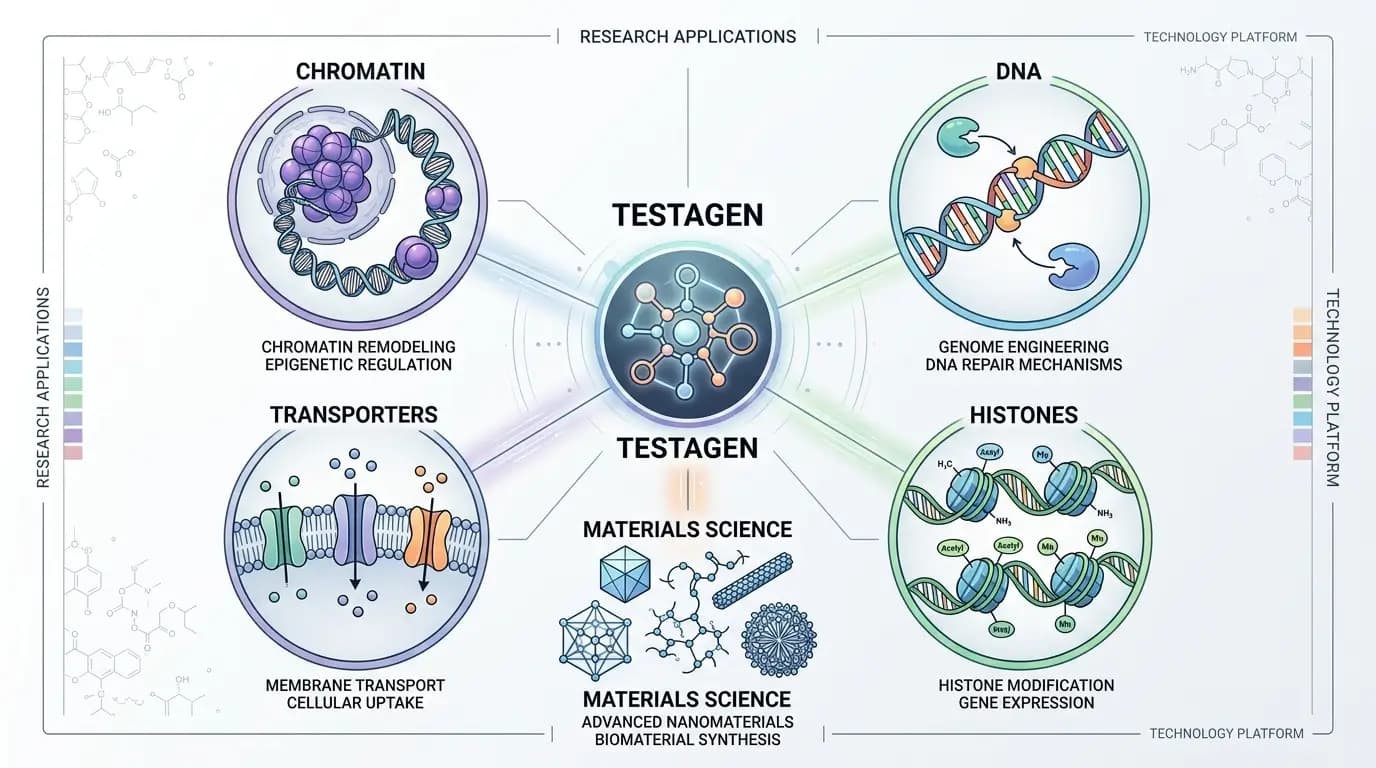
Testagen appears in reviews of peptide-regulated cell differentiation. A 2020 review states that KEDG is among the peptides discussed in directed differentiation of immune cells, and the 2021 systematic review repeats that placement in its summary of differentiation-related peptide activity. That is one reason authors often introduce testagen in broader bioregulator literature rather than in a large stand-alone literature devoted only to KEDG.
Endocrine-system context in review papers
The endocrine context around testagen usually enters through review tables and general descriptions rather than through a deep set of direct, openly accessible KEDG-only studies. For example, the 2021 systematic review lists KEDG under regulation of male reproductive system function, while the broader review text discusses peptides as regulators of endocrine, nervous, and immune-system functions. However, the directly visible mechanistic material remains centered on DNA, histones, transport, and differentiation.
Materials-science work involving testagen
Interestingly, testagen now appears outside the usual peptide-bioregulator conversation as well. A 2025 Molecules paper examined KEDG on copper surfaces in saline environments and reported adsorption behavior and corrosion-inhibition measurements, including an inhibition efficiency of about 86% in that experimental setup. This does not replace the biological literature, but it shows that sequence-defined peptides like testagen can attract attention in more than one research domain.
What this mix of research areas suggests
Taken together, these papers suggest that researchers best understand testagen as a small peptide with a scattered but interesting research footprint. Some papers treat testagen as part of chromatin and gene-expression discussions. Others place testagen in transporter or differentiation models. Still others now examine testagen in materials science. Overall, the pattern is exploratory rather than settled.
How to Read a Testagen Product Page Critically
Data points worth checking first
A stronger testagen page usually includes concrete, checkable fields rather than broad narrative language. For example, these are the first items worth reviewing:
exact testagen sequence
peptide length
molecular formula
molecular weight
purity method and purity value
batch-level COA, HPLC, and MS availability
salt or counterion notes
storage temperature
form, such as lyophilized powder
a clear statement that the material is for laboratory research use only
These fields are more useful than generic descriptive copy because they let the reader verify what the supplier is actually offering.
Why supplier pages can conflict
Supplier pages do not always match each other. One testagen page lists the sequence H-Lys-Glu-Asp-Gly-OH with formula C17H29N5O9 and molecular weight 447.44, while another page uses the same sequence but lists a different formula and lower molecular weight. In contrast, the sequence identity itself is stable across those pages. Therefore, sequence and batch documents usually deserve more trust than headline claims or copied specification blocks.
Handling, storage, and documentation
Catalog-style sources often state that suppliers provide testagen in lyophilized form and store it in a freezer at or below -20 °C. Some pages also mention TFA as a common counterion left from HPLC purification, noting that it can affect appearance, solubility, and net mass. Those are the kinds of practical details that belong on a careful testagen page because they help frame laboratory handling and record-keeping.
What the Current Literature Does Not Establish

The direct evidence base is still limited
The published material that mentions testagen is much smaller than the amount of online copy written about it. Several pages on the open web repeat similar endocrine language, but the stronger accessible papers focus on KEDG as part of wider ultrashort-peptide research rather than offering a large stack of direct, sequence-specific studies devoted only to testagen.
Why marketing language can outrun the papers
This gap matters because readers may see very confident statements on vendor pages and assume the literature provides equal detail. Yet many of the recurring mechanistic points trace back to the same cluster of papers on cell entry, DNA interaction, histone binding, and differentiation. In short, testagen has a real research footprint, but that footprint is narrower than the marketing layer built around it.
What a careful reader should conclude
A careful reader should treat testagen as a peptide with identifiable chemistry, a recognizable place in ultrashort-peptide literature, and a set of preliminary mechanistic discussions that remain open to further validation. Moreover, a careful reader should avoid collapsing testagen into testosterone simply because the names look similar. The better approach is to check sequence, trace claims back to papers, and keep conclusions proportionate to the evidence.
Conclusion
One best understands Testagen as the tetrapeptide KEDG, defining it first by its sequence and only second by the narratives built around it. The current literature places testagen in ultrashort-peptide research involving cellular localization, DNA and histone interaction, transporter modeling, and differentiation-related discussion. At the same time, the open literature on testagen remains limited, so sequence verification, batch documents, and careful claim-checking are essential when reading any testagen page. For beginners, the next step is simple: start with the sequence and the cited papers. For researchers, the next step is equally clear: separate reusable analytical facts from broad copy and follow only what the literature can support.