Oxytocin Peptide is one of the best known signaling molecules in peptide science. It is a naturally occurring nonapeptide made in the hypothalamus and released through the posterior pituitary, and researchers study it in relation to reproduction, social signaling, and broader endocrine regulation.
Many readers first meet Oxytocin Peptide through the label “love hormone.” However, that label compresses a much larger research story. Reviews link oxytocin with bonding, social salience, lactation, and labor, yet those same sources also show that context, receptor distribution, and study design shape how scientists interpret the molecule.
For beginners, Oxytocin Peptide can look simple because the molecule is short and familiar. In reality, oxytocin connects neurobiology, endocrinology, reproduction, and behavior in ways that remain active areas of investigation. Therefore, a useful article on Oxytocin Peptide should explain the core biology, the current evidence, and the limits of common online claims. That broader story is why Oxytocin Peptide keeps attracting attention.
What Oxytocin Peptide Is and Why It Is Called the Love Hormone
Oxytocin Peptide as a Naturally Occurring Peptide Hormone
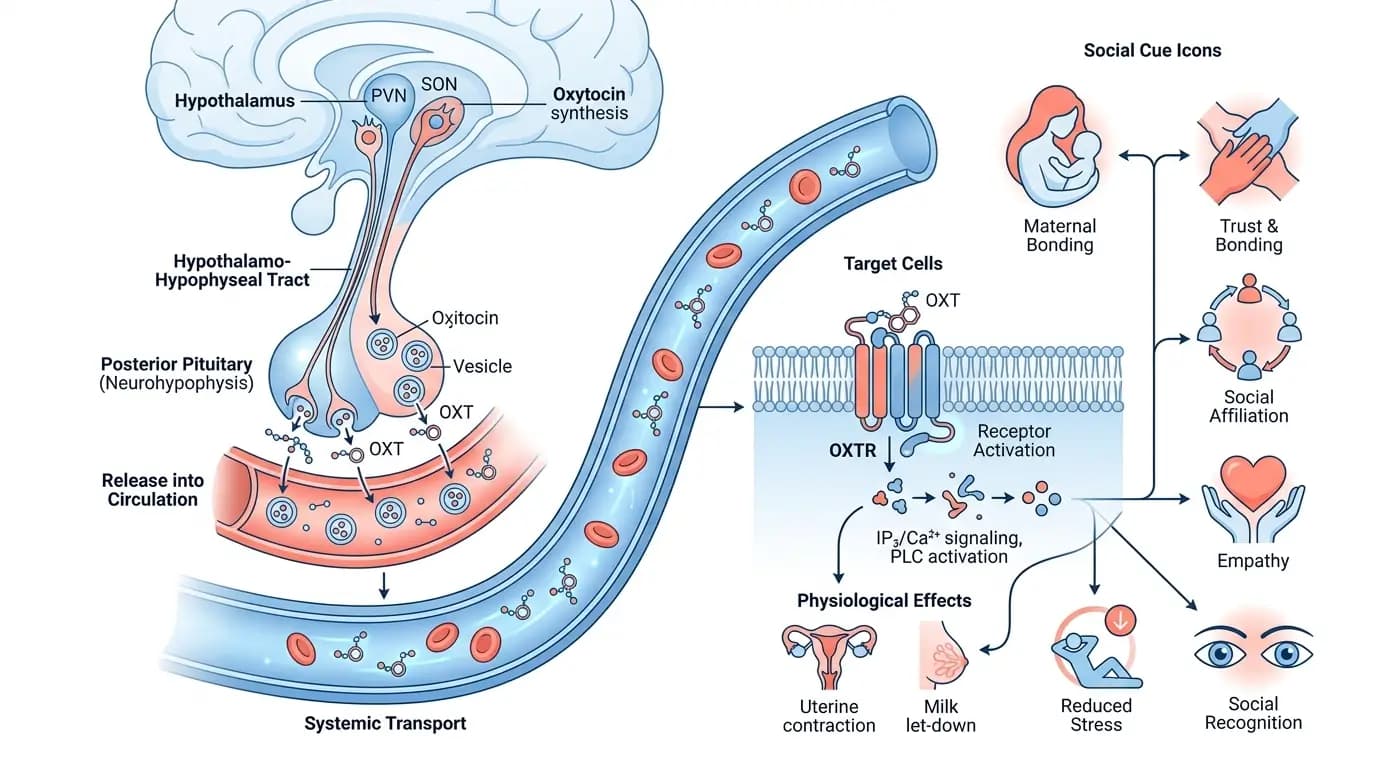
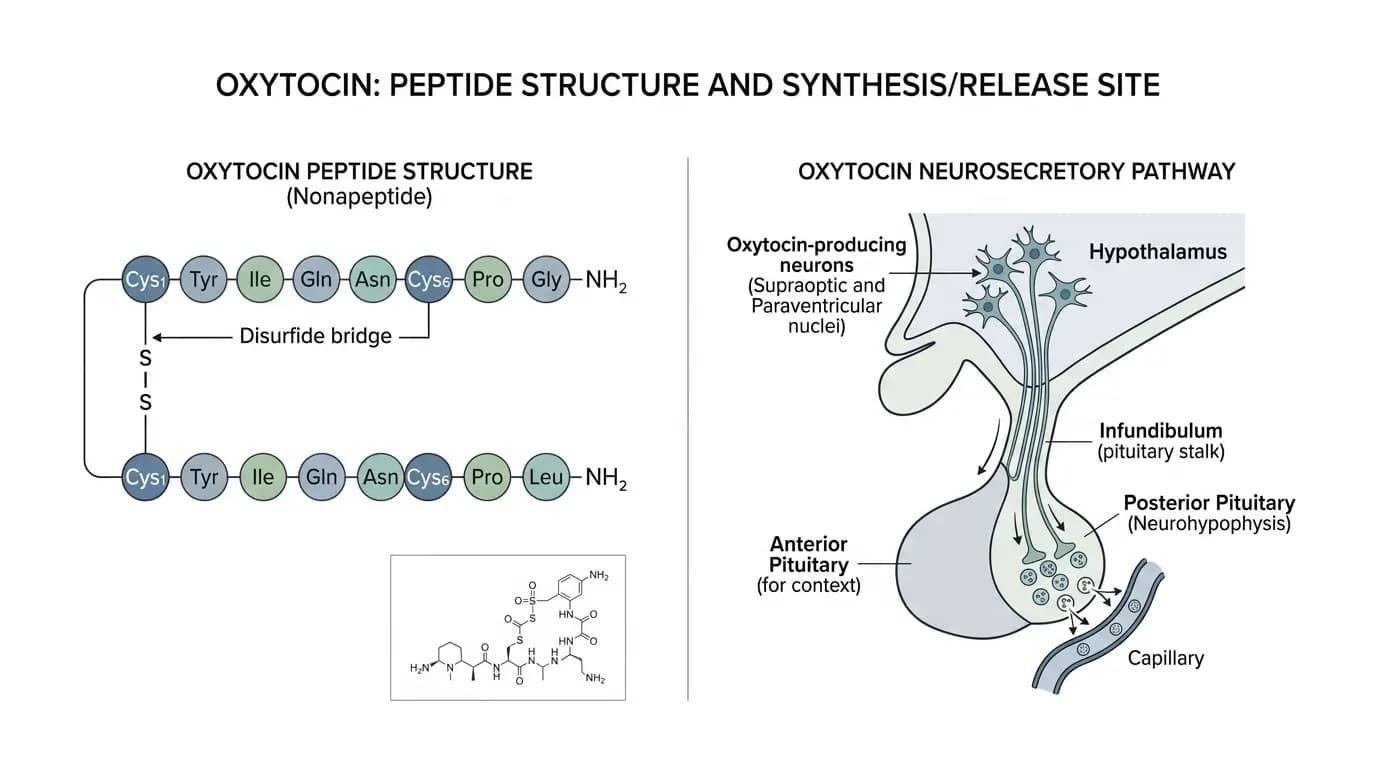
Oxytocin Peptide is a naturally occurring peptide hormone made by magnocellular neurons in the supraoptic and paraventricular nuclei of the hypothalamus. Those neurons project to the posterior pituitary, where the oxytocin system forms part of the neurohypophysis.
Endotext describes the neurohypophysis as a structural and functional unit made up of the hypothalamus, the supraoptico-hypophyseal tract, and the posterior pituitary. In that framework, oxytocin has a clear anatomical origin and a clear release pathway.
Oxytocin is also chemically distinctive. Endotext notes that oxytocin and vasopressin are cyclical peptides that differ at only two amino acid positions, and both contain a disulphide bridge between cysteine residues at positions 1 and 6. Accordingly, Oxytocin Peptide often appears in discussions of closely related neurohypophyseal signals.
This mini-table shows how researchers usually frame Oxytocin Peptide:
Feature | Research description |
|---|---|
Molecule class | Naturally occurring nonapeptide |
Main origin | Hypothalamic neurons |
Main release route | Posterior pituitary and central pathways |
Main research themes | Reproduction, social signaling, endocrine regulation |
Overall, this map shows why oxytocin draws attention across several fields at once.
Why Oxytocin Peptide Is Linked to Bonding, Trust, and Social Behavior
Oxytocin became widely associated with bonding because reviews and meta-analytic work connect endogenous oxytocin with human social interactions, attachment-related cues, and social salience.
However, oxytocin does not act like a single switch for affection or trust. A repeated theme in the literature is that oxytocin can amplify the salience of social information rather than generate one universal emotional pattern.
By comparison, public summaries often skip that nuance. They turn oxytocin into one short label, even though the underlying research spans many tissues, species, and social settings.
How Oxytocin Peptide Works in the Body
Its Role in the Brain, Nervous System, and Hormone Signaling
Oxytocin works through both peripheral release and central signaling. Endotext notes that oxytotic magnocellular neurons project to the posterior pituitary, while additional pathways support central release through dendritic diffusion and axonal projections into extra-hypothalamic areas.
That dual organization matters because oxytocin is not limited to one anatomical route. It can move through endocrine pathways into circulation, and it can also act within neural systems that shape behavior and sensory processing. In addition, receptor-mediated signaling helps explain why one molecule can influence different tissues in different ways.
The 2025 Endocrine Reviews article describes oxytocin as a hypothalamic-posterior pituitary hormone with effects that range from energy homeostasis to bone health and psychological function, alongside its well-known role in labor and lactation. As a result, Oxytocin Peptide sits inside a broader regulatory network rather than inside a narrow single-purpose pathway.
How Oxytocin Peptide Levels Are Released and Regulated
Oxytocin does not move through the body in a flat and constant pattern. Neural firing, sensory input, reproductive state, and feedback loops shape when oxytocin enters circulation or central pathways. Endotext explains that the neurohypophysis coordinates responses to changes in both the internal and external environment, which helps explain why oxytocin findings often look context dependent.
For example, sensory cues related to lactation can trigger synchronized neuronal activity. Likewise, reproductive cues linked to labor can increase uterine responsiveness to oxytocin. Therefore, researchers do not interpret oxytocin as a background signal that means the same thing in every condition.
This point matters because readers often look for one formula. Instead, scientists compare timing, tissue, receptor distribution, and experimental design when they assess oxytocin findings.
The Main Functions Associated With Oxytocin Peptide
Pregnancy, Labor, and Breastfeeding
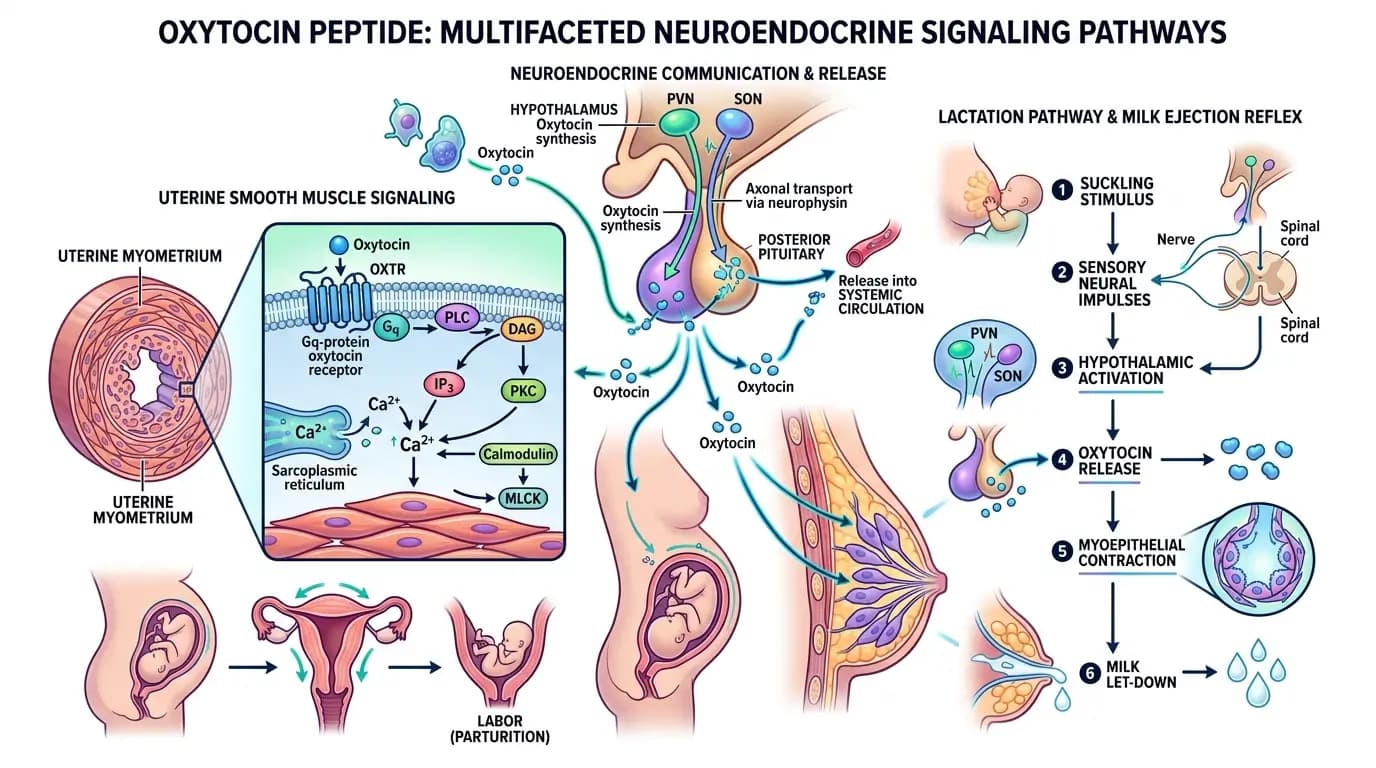
The most established physiology around oxytocin involves labor and lactation. DailyMed notes that synthetic oxytocin acts on uterine smooth muscle to stimulate contractions, and the Endocrine Society review identifies labor and lactation as two of the molecule’s best-known functions.
Still, oxytocin does not operate in isolation. Uterine responsiveness changes with reproductive state, and several endocrine and tissue-level variables shape what researchers observe. For that reason, oxytocin should be understood as part of a coordinated physiological system.
Social Connection, Emotion, and Stress Response
Oxytocin also appears in research on social behavior, emotion, and stress-related signaling. Reviews describe links among oxytocin, social motivation, maternal nurturing, social reward, and the salience of social stimuli.
However, researchers do not present oxytocin as a universal social shortcut. Familiarity, social setting, sex, developmental stage, and individual traits can influence what scientists observe when they study oxytocin pathways.
In contrast, simplified summaries often imply that oxytocin always supports warmth or trust in the same way. The research record does not support that level of certainty.
Why Oxytocin Peptide Is Discussed in Research and Public Conversations
Interest in Mood, Behavior, and Relationship-Related Effects
Oxytocin Peptide attracts broad attention because it links measurable biology with topics people already recognize. Bonding, attachment, caregiving, social cues, and affiliation all make the molecule easier to discuss outside specialist literature.
Moreover, oxytocin research spans animal models, observational work, receptor biology, and endocrine review literature. That breadth means Oxytocin Peptide appears in textbooks, review papers, and general science explainers.
At the same time, broad visibility creates a communication problem. When oxytocin moves from specialist literature into mass discussion, subtle findings can turn into oversized claims. For that reason, careful writing should keep Oxytocin Peptide tied to clearly described models and clearly described limits.
Interest in Metabolism and Broader Physiological Pathways
Oxytocin Peptide is not limited to reproduction and social behavior. The Endocrine Society review highlights oxytocin in relation to energy homeostasis, bone health, and psychological function, which shows how far the research map has expanded.
This broader scope explains why new readers continue to search for oxytocin. Some arrive through neuroscience, while others arrive through endocrine science or general peptide research. In either case, Oxytocin Peptide offers a clear example of how one endogenous signal can connect multiple physiological systems.
Still, broader interest does not remove the need for discipline. Researchers can study oxytocin across many pathways, yet a research-focused website should not turn those pathways into inflated promises.
What Current Research Says About Oxytocin Peptide

Areas Where Findings Look Most Established
Current literature supports several stable conclusions about Oxytocin Peptide. Scientists agree that oxytocin is a hypothalamic-posterior pituitary signal, that it plays key roles in labor and lactation, and that it participates in social and behavioral research with context-dependent results.
Researchers also agree that oxytocin belongs to a wider neuroendocrine system rather than to a single isolated pathway. Endotext describes central and peripheral release routes, while modern reviews connect oxytocin to homeostasis, psychological function, and reproductive signaling.
For beginners, the strongest takeaway is simple. Oxytocin is well characterized at the level of core physiology, and that solid base explains why the molecule keeps drawing scientific attention.
Why Many Claims Remain Simplified or Overstated
Where the literature becomes harder is interpretation. Oxytocin research varies by assay method, species, model, social setting, and endpoint. A systematic review and meta-analysis on endogenous oxytocin and human social interactions reflects that complexity, and broader reviews on myths and metaphors warn against narrow popular narratives.
Therefore, a strong scientific explanation does not ask one peptide to explain every social outcome. Instead, it asks narrower questions about model choice, tissue, timing, and cues. Those questions help readers understand oxytocin without stretching the evidence too far.
In summary, oxytocin stands on firm biological ground, but many headline-style claims outrun that ground.
Regulated Use, Research Use, and Common Misunderstandings
The Difference Between Regulated Obstetric Use and General Marketing
Oxytocin appears in regulated obstetric settings, and DailyMed describes synthetic oxytocin in relation to uterine contractions and hospital supervision. DailyMed also states that oxytocin must be administered with adequate supervision in a hospital when used for induction or stimulation of labor.
That setting differs sharply from the way some sellers or public discussions frame oxytocin. A research page is not the same thing as a regulated product label, and a research article should not blur those categories. Accordingly, research communication about Oxytocin Peptide works best when it stays focused on identity, literature context, analytical documentation, and storage standards.
This distinction is especially important online. When public-facing content implies that an unapproved item is reliable for a specific ailment or equivalent to a regulated drug, Google Ads policy flags that kind of promotion under its unapproved substances rules.
Why Natural Hormone Function Is Not the Same as Product Claims
A naturally occurring hormone can have established physiology and still be misrepresented in marketing. FDA states that unapproved drugs may reach the market without the review standards applied before marketing, and Google Ads policy restricts promotion that implies an unapproved product is reliable for preventing, curing, or addressing a disease or ailment.
For that reason, a research-focused website should not use normal oxytocin biology as a shortcut for product claims. Instead, it should describe Oxytocin Peptide as a molecule under study, explain what published literature has examined, and avoid language that turns physiological discussion into direct human-use messaging.
A simple list helps clarify the difference:
endogenous oxytocin biology describes what the body naturally does
regulated labels describe specific supervised settings
research pages describe identity, documentation, and study context
marketing claims can become misleading when they erase those boundaries
Overall, that separation keeps oxytocin content clearer and more research focused. It also keeps Oxytocin Peptide grounded in evidence-first communication.
Risks, Variation, and Key Limits
Why Oxytocin Peptide Findings Can Vary by Context and Individual Response
Oxytocin findings can vary because oxytocin biology depends on context. Reviews discuss social salience, developmental state, familiarity, and experimental setting as variables that influence observed outcomes.
Likewise, endocrine context matters. Reproductive state can change uterine sensitivity, and central versus peripheral pathways can shift how researchers interpret a result. Therefore, oxytocin does not offer one fixed meaning across all models.
For readers, this variability is not a flaw in the science. It is part of the science, because oxytocin sits inside a living regulatory network.
Why Simplified Emotional and Behavioral Claims Can Mislead
Simplified emotional claims can mislead because they remove the conditions that give oxytocin findings their meaning. A social cue in one setting may not carry the same salience in another setting. In addition, a result from one species or one protocol may not map neatly onto a broader conclusion.
As a result, oxytocin deserves careful wording. It makes more sense to say that researchers study Oxytocin Peptide in relation to social salience, bonding, and endocrine signaling than to say that Oxytocin Peptide guarantees a single emotional outcome.
That distinction protects scientific clarity and helps new readers understand why oxytocin research remains active after decades of study.
Legal, Compliance, and Product-Positioning Considerations

The Difference Between Regulated Products, Research Catalogs, and Public Promotion
A compliant research page for Oxytocin Peptide should describe the molecule as a laboratory material and a research subject. It can explain sequence class, analytical records, storage expectations, literature context, and sourcing documentation. It should not slide into direct human-use framing.
Google Ads states that some healthcare-related content cannot be advertised at all, while other categories require approval and location limits. Google also does not allow the promotion of products that imply they are equivalent to regulated drugs or positioned for a disease or ailment.
For that reason, product-positioning language matters. When a page uses oxytocin as a research term, cites literature carefully, and keeps the tone catalog-like, it aligns better with the boundaries that platform and regulatory sources describe.
Why Human-Use Claims Create Additional Compliance Risk
FDA states that federal law requires new drugs in the United States to meet review standards for their intended use before marketing, and FDA notes that some drugs remain on the market without required approval. Therefore, content that nudges readers from research language toward direct use claims can create additional regulatory risk.
This is why research-focused communication needs restraint. Oxytocin content can stay informative without promising outcomes. It can stay detailed without giving personal-use direction. It can stay useful by showing what the molecule is, where it fits in the literature, and how a serious supplier should present documentation.
For laboratory research use only. Not intended for use in humans or animals. No disease-related purpose is stated or implied.
Oxytocin Peptide and Peptide Researches
How Peptide Researches Supports Research-Focused Sourcing, Documentation, and Compliance-First Communication
Peptide Researches can present oxytocin in a way that matches scientific clarity and platform expectations. A strong Oxytocin Peptide page should center on identity, purity reporting, analytical documentation, storage language, batch-level records, and concise literature summary. Those elements help readers evaluate Oxytocin Peptide as a research material rather than as a shortcut to a personal outcome.
In practice, that means Peptide Researches should describe oxytocin with catalog-style wording. For example, a page can explain that oxytocin is a naturally occurring nonapeptide, note that the oxytocin system belongs to the hypothalamic-posterior pituitary axis, and summarize how researchers study it in relation to reproduction, social salience, and broader endocrine pathways.
Moreover, Peptide Researches can strengthen trust by showing documentation instead of emotional copy. That approach keeps Oxytocin Peptide aligned with a research-first identity.
Conclusion
Oxytocin Peptide remains one of the most recognizable subjects in peptide science because it sits at the intersection of reproduction, social signaling, and endocrine regulation. The molecule is small, yet the literature around Oxytocin Peptide is broad and active.
However, the strongest way to understand Oxytocin Peptide is not through a nickname. It is through anatomy, signaling, receptor biology, and study context. When readers approach Oxytocin Peptide that way, they can separate established physiology from broader interpretation and separate serious research language from inflated promotion.
For Peptide Researches, that distinction matters. A well-built Oxytocin Peptide article should educate beginners, support researchers, and keep every section aligned with a research-focused standard. In that setting, Oxytocin Peptide does not need hype. The science already gives it enough significance.