What Are Incretin Mimetics?
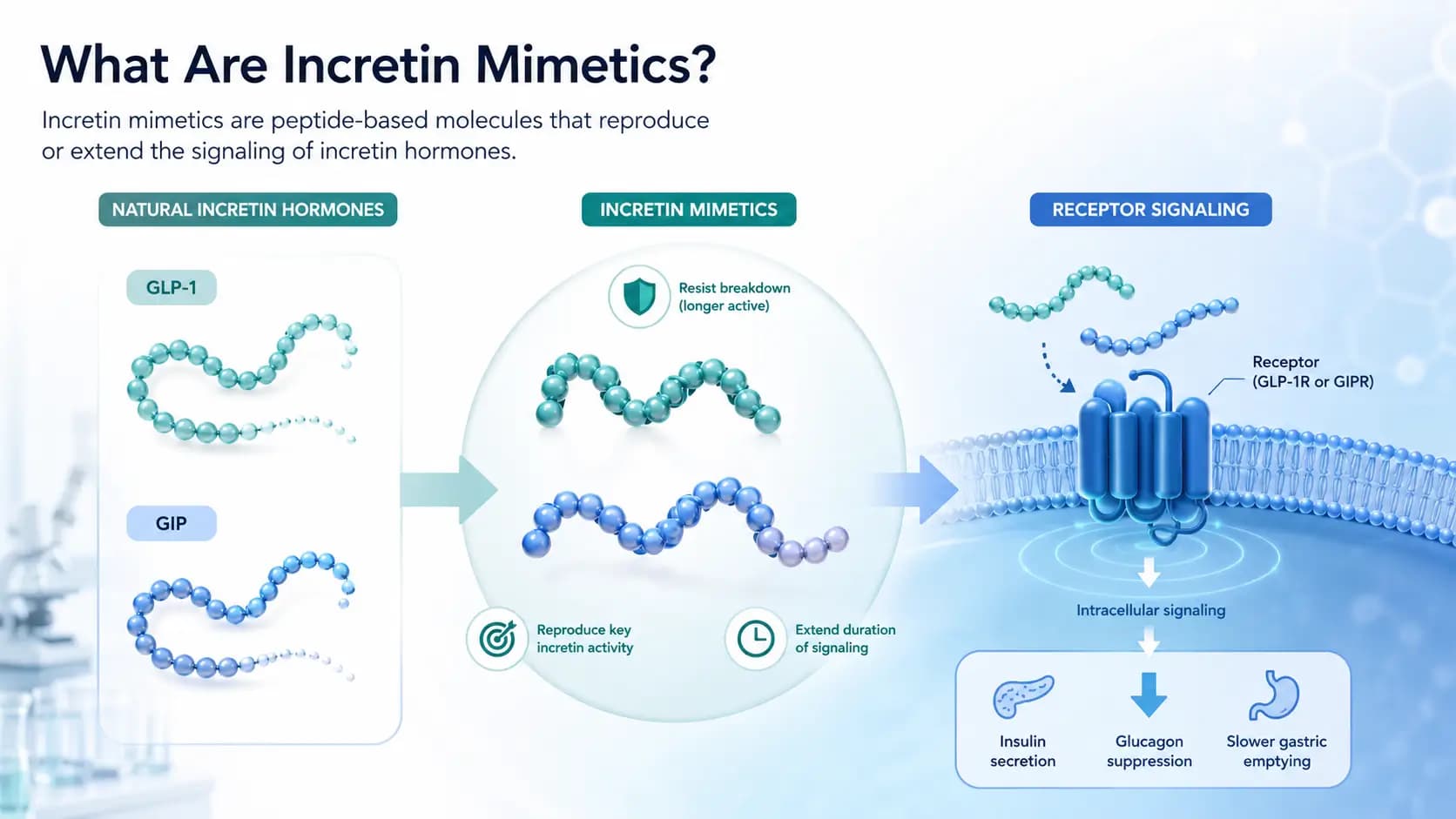
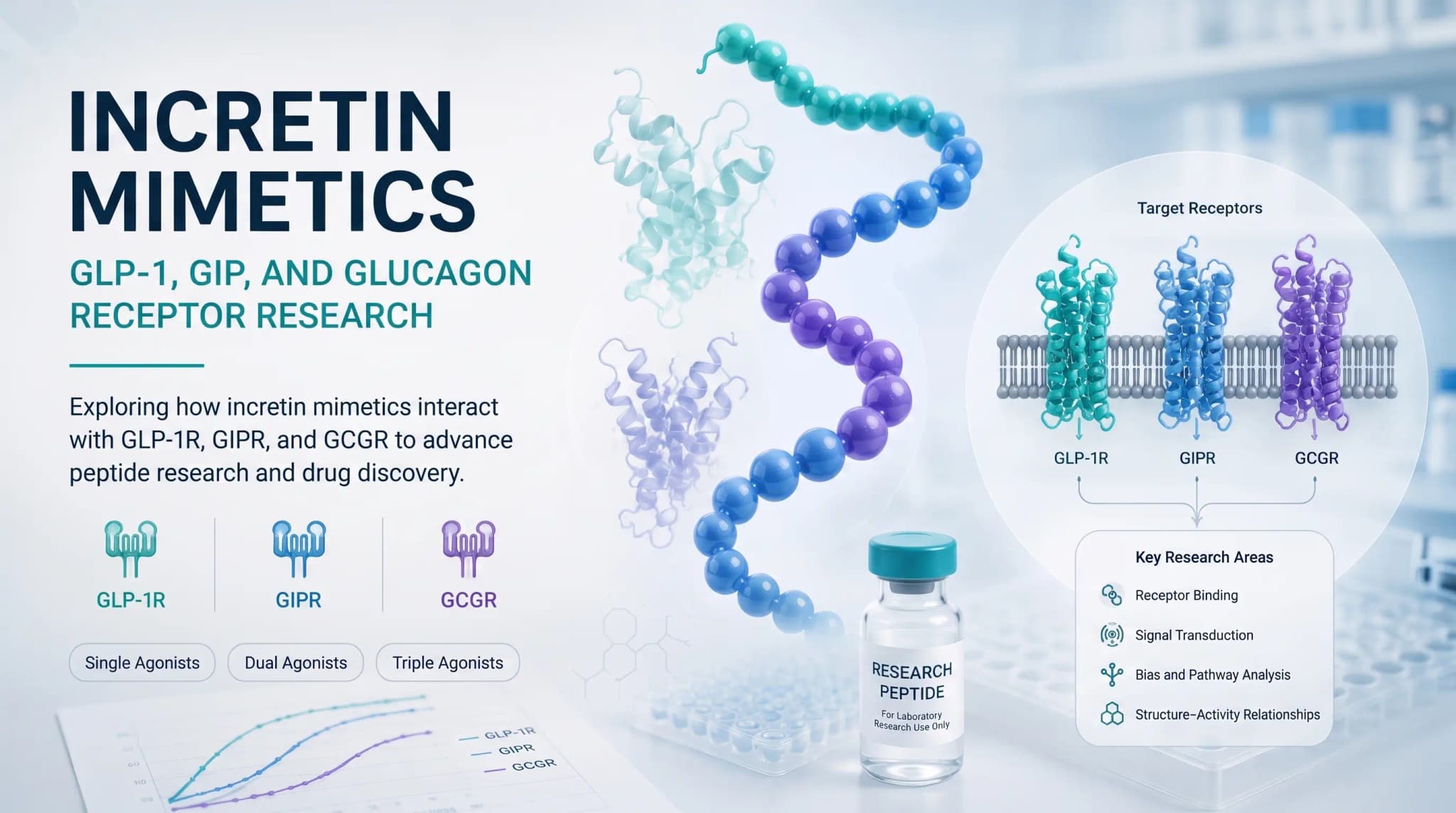
Incretin mimetics are compounds designed to reproduce or extend signaling associated with incretin hormones, especially glucagon-like peptide-1 (GLP-1) and glucose-dependent insulinotropic polypeptide (GIP). Modern incretin-based research also includes dual- and triple-receptor agonists that combine GLP-1, GIP, and, in some designs, glucagon receptor activity within a single molecule.
The term incretin mimetics is most traditionally associated with compounds that reproduce aspects of endogenous GLP-1 signaling. However, the field has expanded considerably. Researchers now investigate molecules with activity at one, two, or three related receptor systems, creating a broader framework for studying receptor selectivity, signaling bias, multi-agonism, and peptide engineering.
The two classical incretin hormones are GLP-1 and GIP. Human receptor-antagonist studies have demonstrated that both contribute to post-meal metabolic signaling and that their actions are related but not identical.
Glucagon is not itself a classical incretin. Its receptor is nevertheless relevant to the modern incretin-based research landscape because newer multi-receptor molecules may intentionally combine glucagon receptor activity with GLP-1R and GIPR agonism.
This creates three useful levels of research:
Single-receptor agonism, commonly centered on GLP-1R
Dual-receptor agonism, such as combined GIPR/GLP-1R activity
Triple-receptor agonism, combining GIPR, GLP-1R, and GCGR activity
Rather than treating these molecules as interchangeable, researchers compare their receptor profiles, molecular structures, signaling characteristics, and behavior within specific experimental systems.
For laboratory research purposes, the key question is therefore not simply whether a compound is an “incretin mimetic.” A more informative question is:
Which receptors does the molecule engage, with what relative activity, and under what experimental conditions?
This article discusses incretin-related compounds strictly in a scientific and research context. It does not provide human-use, therapeutic, or dosing guidance.
Core Incretin and Receptor Pathways: GLP-1, GIP, and Glucagon
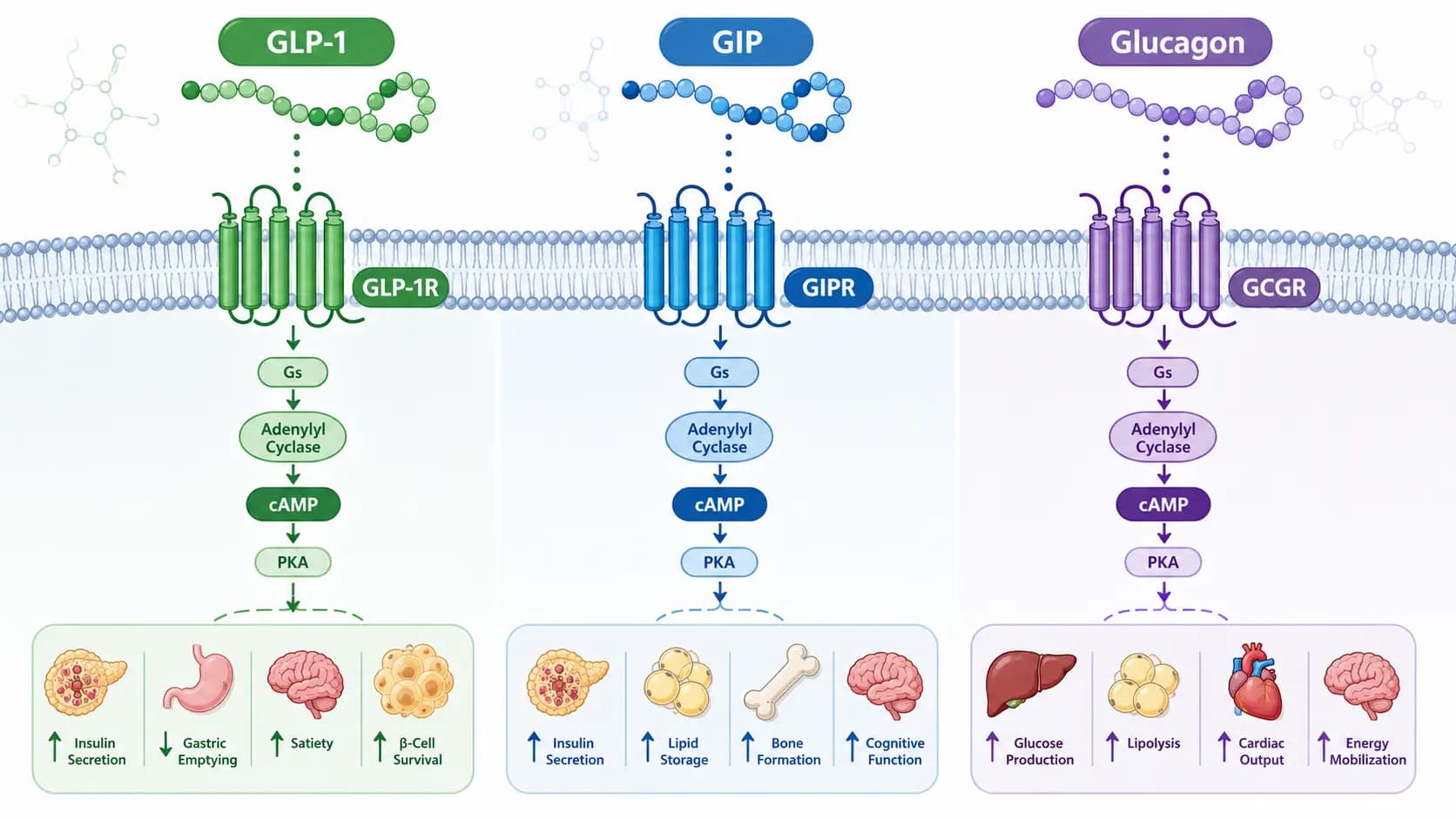
Understanding incretin mimetics begins with the endogenous signaling systems that inspired their design.
GLP-1 and the GLP-1 Receptor
Glucagon-like peptide-1 is one of the two classical incretin hormones. It is released after nutrient exposure and signals through the GLP-1 receptor (GLP-1R).
Experiments using the GLP-1 receptor antagonist exendin(9-39) have helped establish that endogenous GLP-1 contributes to postprandial regulation in humans. Blocking GLP-1R alters glucose-related responses, demonstrating that the pathway has a measurable physiological role rather than functioning only when activated pharmacologically.
At the receptor level, GLP-1R belongs to the class B family of G-protein-coupled receptors. Experimental activation is commonly evaluated through signaling outputs such as cyclic AMP, receptor trafficking, internalization, and additional downstream pathways.
For peptide researchers, GLP-1R provides a particularly useful model because multiple natural ligands, synthetic analogues, and engineered receptor agonists have been characterized against the same receptor system.
GIP and the GIP Receptor
Glucose-dependent insulinotropic polypeptide is the second classical incretin hormone and signals through the GIP receptor (GIPR).
Like GLP-1R, GIPR is a class B GPCR and is frequently studied using receptor-binding and functional signaling assays. Human antagonist studies indicate that GIP and GLP-1 both contribute to incretin-related physiology while maintaining distinct effects.
GIPR has become especially important to peptide research because modern multi-receptor molecules can combine GIPR activity with GLP-1R agonism.
This raises questions that do not exist in a purely single-receptor system:
How active is a molecule at GIPR relative to GLP-1R?
Is receptor engagement balanced or biased?
Does the assay system change the apparent ratio?
Does the molecule recruit the same intracellular pathways at both receptors?
Does receptor trafficking differ between the two targets?
These questions are central to understanding dual-receptor molecules.
Glucagon and the Glucagon Receptor
Glucagon is not classified as an incretin hormone, but the glucagon receptor (GCGR) has become increasingly relevant to multi-receptor peptide research.
GCGR is structurally related to GLP-1R and GIPR, and triple-agonist research has created molecules capable of engaging all three receptor systems.
Retatrutide provides a prominent example. Primary molecular research describes retatrutide, originally identified as LY3437943, as a peptide agonist at GIPR, GLP-1R, and GCGR. Structural work has subsequently visualized its interaction with all three receptors.
This makes glucagon receptor activity useful when studying how a molecule can be engineered to distribute agonism across several related GPCR targets.
Comparing the Three Receptor Systems
Pathway | Endogenous ligand | Receptor | Research relevance |
|---|---|---|---|
GLP-1 | GLP-1 | GLP-1R | Single-receptor agonism, signaling, ligand engineering |
GIP | GIP | GIPR | Incretin physiology, dual agonism, receptor balance |
Glucagon | Glucagon | GCGR | Multi-receptor design and triple agonism |
The distinction is important: GLP-1 and GIP are classical incretins; glucagon is not. GCGR enters the discussion because of the design of newer multi-receptor agonists.
Single-, Dual-, and Triple-Receptor Agonist Research
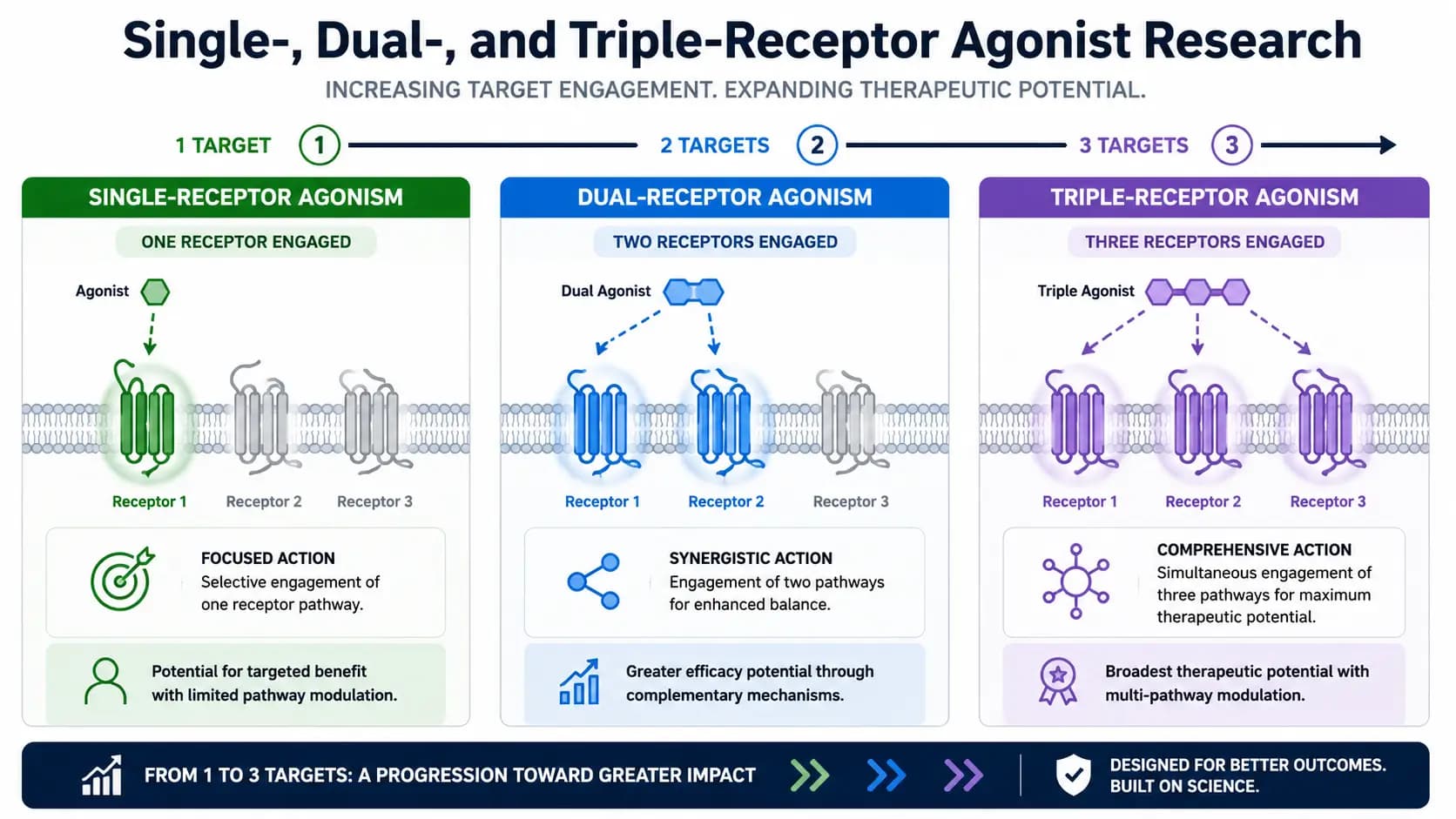
One of the clearest ways to organize incretin-related research compounds is by the number of receptor systems they are designed to activate.
Single-Receptor Agonism
A single-receptor agonist predominantly targets one receptor system.
For this field, the most familiar example is selective GLP-1R agonism.
Single-target compounds are especially useful for establishing a reference pharmacological profile. Researchers can study:
receptor affinity
potency
efficacy
internalization
signaling bias
structural modifications
ligand stability
without simultaneously interpreting activity at several intended targets.
Semaglutide provides an extensively characterized GLP-1 analogue. Its development involved peptide engineering and a fatty-acid-containing side chain designed to support prolonged exposure while maintaining GLP-1R activity.
That makes a well-characterized single-receptor molecule useful as a reference when examining more complex multi-receptor designs.
Dual-Receptor Agonism
Dual agonists are designed to engage two receptor systems through one molecular construct.
Within incretin research, the most prominent combination is:
GIPR + GLP-1R
Tirzepatide is a well-studied example.
Importantly, calling a molecule a dual agonist does not mean it necessarily behaves identically at both receptors.
Primary pharmacological research on tirzepatide found an imbalanced and receptor-specific signaling profile. In experimental systems, tirzepatide showed stronger relative engagement of GIPR and distinct signaling behavior at GLP-1R, including differences between cAMP signaling, β-arrestin recruitment, and receptor internalization.
This illustrates an important principle:
The number of receptor targets alone does not fully describe a multi-agonist.
Researchers also need to ask:
What is the relative potency at each receptor?
What is the maximal functional response?
Does the ligand show pathway bias?
Does it alter receptor trafficking?
Are results consistent across assay systems?
Triple-Receptor Agonism
Triple agonists add a third receptor target.
In the incretin-based research landscape, this commonly refers to combined:
GIPR + GLP-1R + GCGR
Retatrutide is a prominent example.
The original molecular characterization of LY3437943 described agonist activity at all three receptor systems. The reported in-vitro profile was not simply equal activation of three receptors: investigators observed comparatively greater GIPR activity alongside activity at GLP-1R and GCGR.
Later structural research examined retatrutide bound to GLP-1R, GIPR, and GCGR, providing molecular-level evidence of how one peptide can interact with three related class B GPCRs.
Triple agonism therefore creates a more complex experimental problem than simply adding another receptor.
Researchers may need to characterize:
individual receptor potency
relative receptor activation
pathway-specific signaling
structure–activity relationships
receptor occupancy
cross-receptor selectivity
model-dependent differences
Why Receptor Combinations Matter
Single-, dual-, and triple-receptor compounds answer different scientific questions.
Design | Primary research question |
|---|---|
Single agonist | How does this ligand interact with one principal receptor system? |
Dual agonist | How does one molecule distribute activity across two related receptors? |
Triple agonist | How can signaling be coordinated across three receptor systems? |
More receptor targets do not automatically mean that one molecule is “stronger” or scientifically superior.
Instead, the receptor architecture changes the experimental question.
That distinction is important when comparing compounds such as semaglutide, tirzepatide, and retatrutide.
How Incretin Mimetics Are Studied and Characterized

Researchers generally need several complementary methods to characterize an incretin-related peptide. A single potency number is rarely enough to explain the complete pharmacological profile of a multi-receptor agonist.
Receptor Binding and Selectivity
Binding experiments evaluate whether and how strongly a ligand interacts with a receptor.
Depending on the system, researchers may use approaches such as competitive ligand assays or other receptor-binding formats.
For multi-receptor compounds, the same molecule may be evaluated separately against:
GLP-1R
GIPR
GCGR
potentially other receptors in broader selectivity panels
This helps distinguish intended multi-agonism from unintended off-target activity.
Binding affinity should not be interpreted as equivalent to functional activity. A ligand may bind strongly while producing different levels or patterns of downstream signaling.
Functional Signaling Assays
Because GLP-1R, GIPR, and GCGR are GPCRs, researchers frequently examine receptor-mediated intracellular signaling.
Common experimental readouts include:
cyclic AMP production
β-arrestin recruitment
receptor internalization
selected phosphorylation pathways
reporter-gene responses
The importance of using more than one functional readout is illustrated by tirzepatide research. Experimental work found that its GLP-1R signaling differed depending on the pathway measured, with distinct behavior for cAMP generation, β-arrestin recruitment, and receptor internalization.
A compound therefore cannot always be summarized accurately with a single EC50 value taken from one assay.
Structural Biology
Structural methods can provide a complementary view of receptor pharmacology.
Cryogenic electron microscopy has been used to examine retatrutide bound separately to GLP-1R, GIPR, and GCGR in receptor–G-protein complexes. These structures help researchers investigate how one peptide accommodates three related but distinct receptor binding environments.
Structural data can be particularly useful for examining:
ligand orientation
receptor-contact residues
differences between receptor complexes
structure–activity relationships
potential explanations for potency differences
Structural evidence does not replace functional assays, but it can help explain them.
Comparative Experimental Models
Receptor pharmacology may also vary according to the experimental system.
Researchers can work with:
recombinant receptor-expressing cell lines
primary cells
isolated tissues
animal models
computational and structural models
Each provides different information.
A recombinant cell system can isolate receptor-specific pharmacology, but receptor abundance may not resemble native tissue. More complex biological models preserve additional interactions but introduce variables that can make mechanistic interpretation more difficult.
The best-supported conclusions therefore tend to come from converging evidence across complementary methods, rather than from one assay in isolation.
Examples of Incretin-Mimetic and Incretin-Based Research Compounds
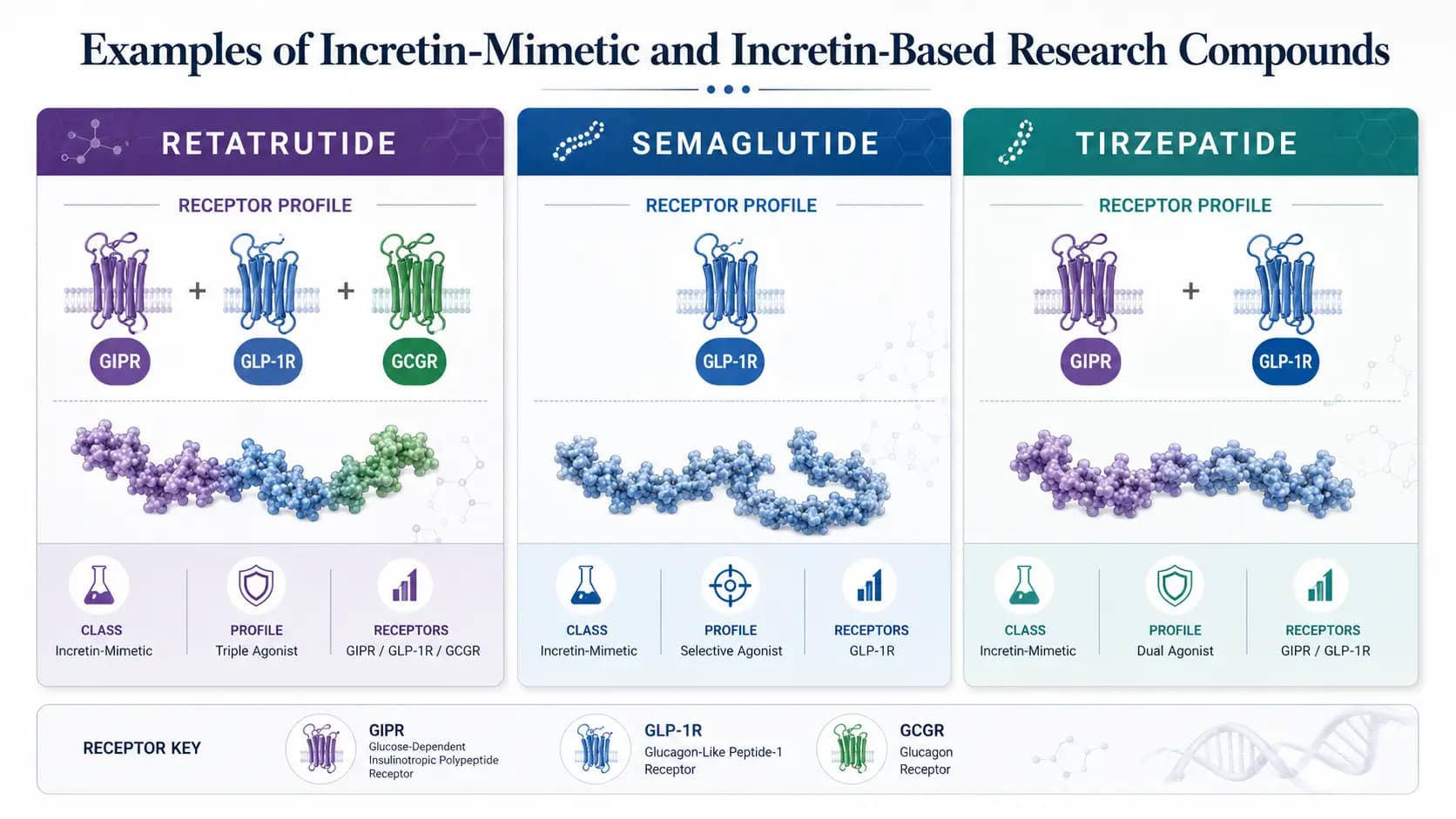
The broader incretin-based agonist landscape includes molecules with very different receptor architectures.
Three useful examples are semaglutide, tirzepatide, and retatrutide.
Retatrutide
Retatrutide is a peptide agonist designed to engage:
GIPR
GLP-1R
GCGR
Its original molecular characterization described a triple-receptor pharmacological profile, and subsequent structural research directly examined retatrutide complexes with all three receptors.
From a research perspective, retatrutide is particularly useful for studying:
triple-receptor agonism
relative receptor potency
multi-receptor structural recognition
signaling balance
structure–activity relationships
Its three-receptor architecture also creates a useful conceptual contrast with single- and dual-receptor agonists.
Researchers examining triple-receptor designs should avoid reducing the comparison to a simple “three versus two versus one” hierarchy. The scientifically relevant distinction is the pattern of activity across receptors and assays. For a deeper compound-level overview, see our Retatrutide research overview.
Researchers interested in triple-receptor compounds can also review available RETA research material and analytical documentation as a contextual next step.
Semaglutide
Semaglutide is a GLP-1 analogue and a useful example of predominantly single-receptor GLP-1R agonism.
Its discovery program investigated structural changes that could extend molecular persistence while maintaining GLP-1 receptor activity. The published medicinal-chemistry work describes sequence optimization and side-chain engineering used during development.
For laboratory comparison, semaglutide provides a well-characterized reference for:
GLP-1R agonism
peptide modification
receptor activity
analogue design
comparison against multi-receptor constructs
This makes it useful when a study requires a GLP-1-focused comparator against dual or triple agonists.
Researchers evaluating GLP-1-focused systems can inspect SEMA research material and available product-specific documentation where relevant.
Tirzepatide
Tirzepatide is a GIPR/GLP-1R dual agonist.
Primary receptor-pharmacology work has shown that its activity is more nuanced than equal stimulation of two receptors. Experimental characterization identified an imbalanced profile and distinct signaling behavior at GIPR and GLP-1R.
That makes tirzepatide useful for studying:
dual-receptor agonism
receptor preference
biased signaling
differences in receptor internalization
multi-target pharmacological characterization
Researchers comparing dual-receptor designs can likewise review TIRZ research material and corresponding analytical information where that serves the experimental context.
Comparison Table
Compound | Research classification | Principal receptor profile | Useful research context |
|---|---|---|---|
Retatrutide | Triple-receptor agonist | GIPR + GLP-1R + GCGR | Triple agonism, receptor balance, structural comparison |
Semaglutide | Predominantly single-receptor agonist | GLP-1R | GLP-1-focused pharmacology and reference comparisons |
Tirzepatide | Dual-receptor agonist | GIPR + GLP-1R | Dual agonism, receptor bias and signaling balance |
This table is intended as a receptor-level overview. Detailed compound-to-compound comparisons require their own analysis because assay design, study population, experimental model, and endpoint selection can materially affect interpretation.
Limitations of Incretin-Mimetic Research
Incretin-related receptor research is increasingly sophisticated, but its evidence must still be interpreted within clearly defined experimental limits.
Different Experimental Models Can Produce Different Results
A receptor-overexpression system does not reproduce every feature of a native biological environment.
Likewise, results from one species cannot automatically be assumed to describe receptor behavior in another.
Important variables include:
receptor density
receptor sequence
cellular background
downstream signaling machinery
experimental duration
ligand concentration
Researchers should therefore identify the model before comparing reported potency or efficacy values.
Assay Choice Can Change the Apparent Profile
A compound can look different depending on which signaling output is measured.
Tirzepatide illustrates this directly: its GLP-1R pharmacology differs across cAMP, β-arrestin, and receptor-internalization measurements.
This means that two publications are not necessarily contradictory simply because their reported values differ.
Before comparing results, researchers should ask whether the studies used:
the same receptor construct
the same species receptor
the same cell background
the same signaling endpoint
the same reference ligand
similar exposure conditions
Multi-Receptor Compounds Are Especially Difficult to Rank
Single-value rankings such as “Compound A is stronger than Compound B” can be misleading in multi-receptor pharmacology.
For example, a triple agonist has several possible potency values because activity can be measured independently at GLP-1R, GIPR, and GCGR.
A scientifically useful comparison therefore needs to specify:
> stronger at which receptor, in which assay, under which conditions?
The same principle applies to dual-receptor agonists.
Structural Evidence and Functional Evidence Answer Different Questions
A structural study can demonstrate how a ligand interacts with receptor binding pockets, but it does not by itself establish the complete functional behavior of the molecule.
Conversely, a signaling assay can measure pathway activity without explaining the exact structural basis for that behavior.
The strongest mechanistic interpretation combines:
structure + binding + functional signaling + appropriate biological models
rather than treating any one approach as definitive.
Evidence Depth Is Uneven
Not every molecule has the same quantity or quality of supporting research.
Semaglutide, tirzepatide, and retatrutide also entered the literature at different times and have different bodies of structural, pharmacological, preclinical, and clinical evidence.
Researchers should therefore avoid assuming that equal visibility means equal mechanistic characterization.
Findings Should Remain Bound to Their Evidence
A receptor assay supports conclusions about receptor activity.
A structural experiment supports conclusions about molecular interaction.
An animal study supports conclusions about that model.
A clinical trial supports conclusions about the participants, protocol, and endpoints investigated.
These evidence types should not be treated as interchangeable.
For research-use interpretation, maintaining that distinction helps prevent overstatement and makes compound comparisons more reproducible.
Conclusion and Related Research
Incretin mimetics have developed from a primarily GLP-1-centered concept into a wider area of receptor and peptide research.
The underlying architecture can be summarized simply:
GLP-1R-focused agonism → GIPR/GLP-1R dual agonism → GIPR/GLP-1R/GCGR triple agonism
But the science is more complex than receptor count alone.
Semaglutide, tirzepatide, and retatrutide illustrate three distinct strategies for engineering peptide-receptor activity. Semaglutide provides a well-characterized GLP-1R-focused reference. Tirzepatide demonstrates how one peptide can distribute activity across GIPR and GLP-1R while showing receptor- and pathway-specific pharmacology. Retatrutide extends multi-agonism to GIPR, GLP-1R, and GCGR and provides a model for studying triple-receptor recognition and signaling.
For researchers, the most useful comparisons therefore focus on receptor profile, potency, efficacy, signaling bias, structure, assay design, and experimental context, rather than treating compounds as interchangeable members of a single class.
Related Research
Readers building a broader foundation should also review:
What peptides are and how peptide structure relates to research applications parent pillar
Retatrutide vs. Tirzepatide focused comparison research
Retatrutide vs. Semaglutide focused comparison research
These narrower topics allow individual search intents to be examined in greater depth without turning this cluster page into an oversized compound-comparison guide.
Research Material Discovery
Where relevant to experimental planning, researchers can also review the available research materials and product-specific documentation for:
Product- and lot-specific analytical documentation should be treated as the authority for the material being evaluated. Availability, specifications, analytical records, and other product information should be checked on the corresponding product page rather than inferred from general educational content.
For laboratory research use only. Not intended for human or veterinary use.
Key Scientific Sources
Gasbjerg LS et al. GIP and GLP-1 Receptor Antagonism During a Meal in Healthy Individuals.
Human randomized receptor-antagonist study.
Lund A et al. Separate and Combined Glucometabolic Effects of Endogenous GIP and GLP-1 in Healthy Individuals.
Human randomized receptor-antagonism study.
Lau J et al. Discovery of the Once-Weekly Glucagon-Like Peptide-1 Analogue Semaglutide.
Journal of Medicinal Chemistry, 2015. DOI: 10.1021/acs.jmedchem.5b00726.
Willard FS et al. Tirzepatide is an imbalanced and biased dual GIP and GLP-1 receptor agonist.
Primary molecular-pharmacology study.
Coskun T et al. LY3437943, a novel triple glucagon, GIP, and GLP-1 receptor agonist: From discovery to clinical proof of concept.
Cell Metabolism, 2022. DOI: 10.1016/j.cmet.2022.07.013.
Li W et al. Structural insights into the triple agonism at GLP-1R, GIPR and GCGR manifested by retatrutide.
Primary structural study, 2024. DOI: 10.1038/s41421-024-00700-0.