
Understanding Certificates of Analysis in Peptide Research: A Comprehensive Guide

Certificates of analysis are foundational documents in peptide research because they connect a physical sample to verifiable analytical testing. In a laboratory setting, researchers rely on certificates of analysis to review identity, purity, batch information, and supporting data before a material enters a study workflow. Accordingly, these records support product verification and help laboratories document quality assurance in a structured way.
For beginners, the idea can seem simple, yet the details matter. A peptide vial label may show a name and lot number, however the certificate of analysis explains how that lot was characterized. In other words, certificates of analysis translate laboratory measurements into a formal record that can be reviewed, archived, and compared across batches.
Definition of Certificates of Analysis
A certificate of analysis, often shortened to COA, is a document issued by a manufacturer or testing laboratory that summarizes the analytical attributes of a specific batch or lot. It commonly includes identifiers such as product name, lot number, date of testing, and test methods used. Furthermore, certificates of analysis usually report whether the sample met predefined specifications for the parameters tested.
In peptide research, this document is not merely administrative. It is part of the evidence trail showing that a material was examined through analytical testing rather than described by label alone. Because research outcomes depend heavily on input quality, certificates of analysis help researchers assess whether a sample is appropriate for non-clinical laboratory work.
Purpose of COAs in Laboratory Research
The main purpose of a COA is to support informed decision-making before a reagent is used in experiments. For example, a researcher may compare purity, peptide content, or identity confirmation across multiple lots before selecting one for a study. Consequently, certificates of analysis reduce uncertainty and improve consistency in experimental planning.
COAs also play a role in documentation and audit readiness. During internal reviews, laboratories may need to show where a material came from, how it was characterized, and whether it aligned with purchasing specifications. Therefore, certificates of analysis contribute to data reporting practices and broader regulatory compliance frameworks.
A practical COA often helps answer questions such as:
What exact lot was tested
Which analytical testing methods were used
Whether the material met stated specifications
When the testing was performed
Which laboratory authorized the report
Overview of Research
Peptides and Their Significance
Research peptides are short chains of amino acids used in scientific investigation across biochemistry, molecular biology, analytical chemistry, and related fields. Researchers study them to examine receptor interactions, binding behavior, degradation pathways, and assay development. However, the context here is strictly laboratory and scientific use, not human or animal administration.
Their significance comes from precision and variability at the same time. A small change in sequence, impurity profile, or handling conditions can alter how a peptide behaves in a research system. As a result, product verification becomes especially important when peptide research depends on reproducibility and traceability.
COA Role in Peptide Research | Why It Matters |
|---|---|
Identity confirmation | Helps verify the correct sequence-related material was received |
Purity reporting | Supports interpretation of experimental noise and contaminants |
Lot traceability | Links results to a specific batch for repeatability |
Data reporting | Creates a documented record for lab files and reviews |
For laboratory research use only. Not intended for use in humans or animals. Not intended to diagnose, treat, cure, or prevent any disease.
Key Components of a Certificate of Analysis
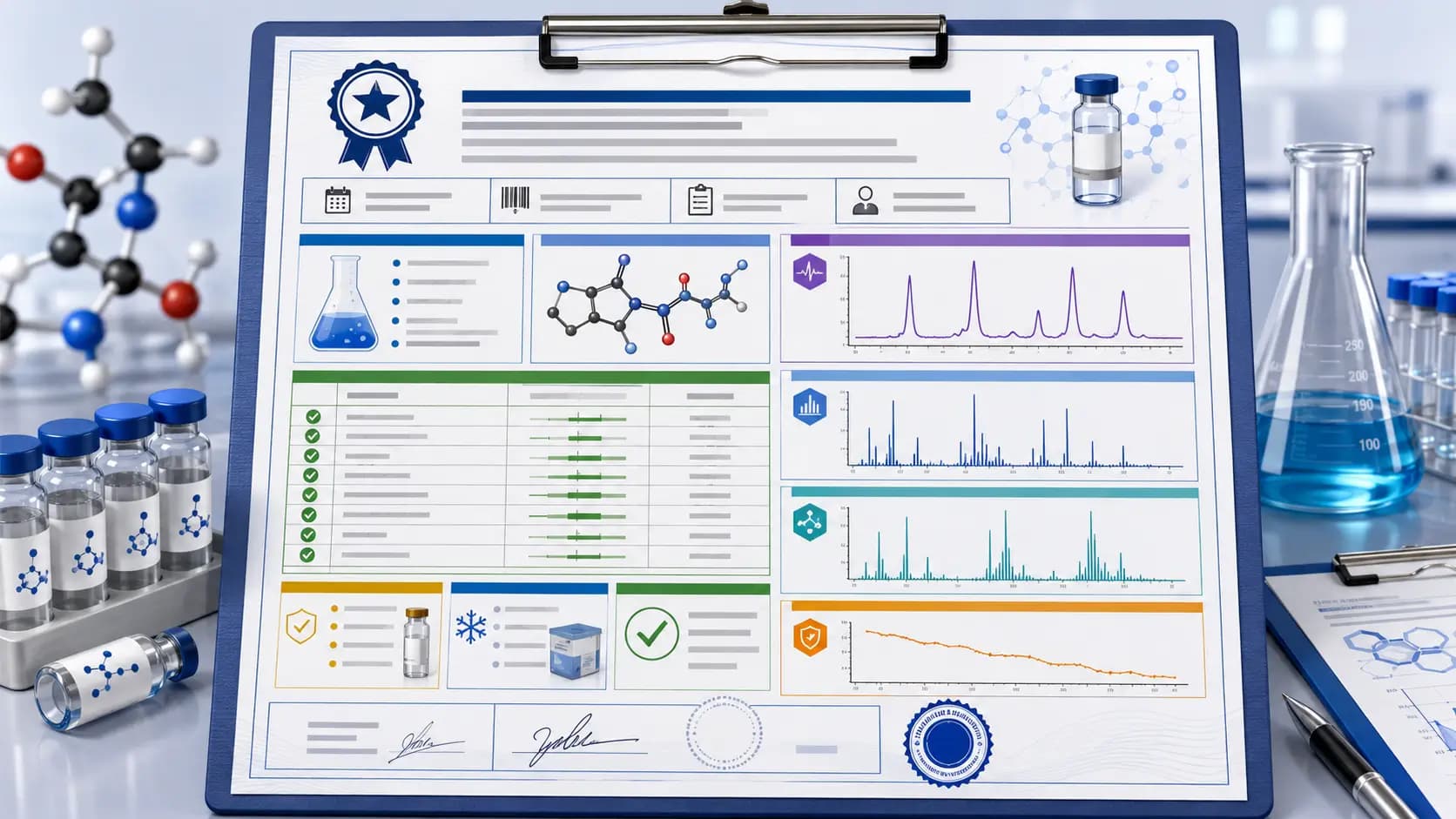
A useful COA is more than a one-page summary with a passing statement. Certificates of analysis should present enough detail to let a researcher understand what was tested, how it was tested, and whether the reported values align with the laboratory's needs. Moreover, a well-structured COA supports product verification by making critical information easy to locate and compare.
When beginners first read certificates of analysis, they often focus only on the purity percentage. Although purity is important, it is only one component of a broader quality picture. Identity, batch traceability, test method references, and signatures or approvals are also central to quality assurance and research integrity.
Essential Elements Included in a COA
Most certificates of analysis contain a core set of identifiers and analytical summaries. These details establish traceability and connect the report to a specific material lot. In addition, they show whether the data refers to the exact sample in hand rather than a generic product profile.
Typical elements include:
Product or material name
Lot or batch number
Catalog or reference number
Manufacturing or release date
Retest or expiration date, if applicable to the supplier system
Storage conditions
Test parameters and results
Specification limits or acceptance criteria
Method references
Authorized approval or quality unit sign-off
Some COAs also include molecular weight, sequence information, appearance, and net content. For peptide research, these fields can help distinguish closely related materials. Likewise, they give researchers a faster way to cross-check labels, inventory systems, and receiving records.
Types of Analytical Tests Conducted
The analytical testing listed on certificates of analysis varies by supplier, material class, and intended research context. Nevertheless, peptide-focused COAs often include tests for identity, purity, and composition. Each test contributes a different piece of evidence, so a single number rarely tells the whole story.
Common analytical methods include high-performance liquid chromatography, mass spectrometry, amino acid analysis, and water content testing. For instance, HPLC is often used to estimate purity by separating components in a sample. Meanwhile, mass spectrometry helps confirm the expected molecular mass and supports identity assessment.
Below is a simplified overview:
Test Type | What It Examines | Common Relevance |
|---|---|---|
HPLC or UPLC | Peak profile and relative purity | Screens for impurities and major component percentage |
Mass spectrometry | Molecular mass | Supports identity confirmation |
Water content | Moisture level | Helps interpret handling and mass-based calculations |
Residual solvent testing | Solvent traces from processing | Adds context to sample composition |
Appearance | Physical description | Basic incoming inspection reference |
Analytical testing may also include microbial screening or elemental checks in some quality systems, however not every peptide COA will contain those items. Because methods differ, researchers should read the method descriptions rather than assume all certificates of analysis are directly comparable. Therefore, side-by-side review of multiple suppliers should consider both the numbers and the methodology.
Understanding Data Reporting and Transparency
Data reporting is the bridge between raw testing and practical interpretation. A transparent COA states the parameter tested, the numerical result, the unit of measure, and the specification used for comparison. Furthermore, transparent certificates of analysis identify the method or instrument class so the reader can judge the strength and scope of the result.
Transparency also means acknowledging limits. A purity figure from chromatographic analysis does not automatically prove full structural identity, and a mass confirmation does not describe every possible impurity. In fact, the most credible certificates of analysis make it clear what was measured and what was not.
Researchers should look for the following signs of strong data reporting:
Clear units such as percent, mg, or ppm
Method names or references
Lot-specific results rather than template language
Dates and version control
Approval by an authorized quality function
When certificates of analysis are vague, missing lot information, or inconsistent with labeling, caution is warranted. Conversely, a transparent COA strengthens quality assurance and supports cleaner recordkeeping. This is especially important in peptide research, where small analytical differences can influence downstream interpretation.
Importance of Certificates of Analysis in Research Integrity

Research integrity depends on reliable inputs, careful records, and reproducible methods. Certificates of analysis support all three by providing documented evidence about the materials entering a study. Because peptide research can be sensitive to identity and purity differences, certificates of analysis help laboratories reduce uncertainty before data collection begins.
For both beginners and experienced researchers, the value of a COA extends beyond procurement. It affects how results are interpreted, how deviations are investigated, and how findings are defended during review. Therefore, certificates of analysis are closely tied to quality assurance, regulatory compliance, and the credibility of data reporting.
Quality Assurance and Control
Quality assurance is the planned system that helps laboratories maintain consistent standards, while quality control focuses on checking whether specific materials or outputs meet those standards. Certificates of analysis contribute to both areas. For example, a receiving team may review a COA against purchasing specifications before releasing a peptide lot into inventory.
This review process can prevent avoidable errors. If a lot arrives with incomplete identity confirmation, mismatched labeling, or unclear purity reporting, the laboratory can quarantine the material pending clarification. Accordingly, certificates of analysis function as an early checkpoint in the control process.
A simple intake review may include:
Verifying lot number matches the container
Confirming test dates and release status
Reviewing identity and purity data
Checking storage conditions
Filing the COA with inventory records
Without this step, laboratories may rely too heavily on supplier claims that are not adequately documented. In contrast, routine COA review strengthens quality assurance and creates a repeatable standard for material acceptance.
Ensuring Compliance with Regulatory Standards
Regulatory compliance in research settings often involves documentation, traceability, and fit-for-purpose material control rather than a single universal rule for every peptide. Certificates of analysis support these expectations by linking analytical testing to a specific lot and by creating an auditable record. Moreover, they help laboratories demonstrate that material review was based on evidence rather than assumption.
FDA guidelines and related quality system expectations place strong emphasis on documentation accuracy, supplier qualification, and data reliability. Although the exact obligations vary by research environment, the principle remains consistent. In other words, if a material affects study quality, the documentation surrounding that material matters.
COAs can support compliance activities in several ways:
Compliance Need | How COAs Help |
|---|---|
Traceability | Connect a study material to a unique lot |
Supplier oversight | Provide a basis for qualification and review |
Record retention | Create a formal document for audit files |
Investigation support | Help assess whether material quality contributed to anomalies |
Competitive sport organizations may restrict certain substances. Users are responsible for checking applicable rules.
Enhancing Research Reliability and Validity
Reliable research requires that results can be reproduced under similar conditions. Valid research requires that the methods and materials align with the question being studied. Certificates of analysis contribute to both aims because they clarify what the material is and how it was characterized. Consequently, they help researchers avoid drawing conclusions from poorly defined inputs.
Consider a peptide assay that yields inconsistent findings across repeated runs. If the lots used in each run have different impurity profiles or weak identity documentation, the variation may reflect material differences rather than true biological or chemical behavior. Hence, certificates of analysis can be essential during troubleshooting.
They also improve communication across teams. A principal investigator, quality reviewer, and analytical chemist can all refer to the same lot-specific document when discussing data quality. Similarly, publications, internal reports, and archived study files benefit when product verification details are consistent and accessible.
In peptide research, research integrity is not protected by a disclaimer alone. It is protected by records, methods, and disciplined review. Certificates of analysis are one of the simplest and most practical tools for maintaining that discipline.
How to Decode a Certificate of Analysis

Reading certificates of analysis becomes easier when you approach them as structured technical records rather than marketing summaries. A COA tells a story about one lot, one set of tests, and one release decision. However, that story is only useful if the reader understands the assay results, technical language, and common limitations in data reporting.
Beginners often ask whether a COA is either valid or invalid in a simple sense. The better question is whether the document is complete, lot-specific, and suitable for the intended laboratory purpose. Accordingly, decoding certificates of analysis means looking at both the reported values and the context around them.
Interpreting Assay Results
An assay result is a measured outcome reported against a specification or reference value. In peptide research, this might include purity percentage, observed molecular mass, water content, or appearance. For example, a purity result of 98 percent may indicate that the major chromatographic peak represents most of the detectable material under the test conditions used.
Still, assay interpretation requires caution. A high purity value does not automatically confirm sequence correctness in every possible way, and a matching mass does not exclude all minor impurities. Therefore, researchers should read multiple test fields together rather than relying on one headline number.
A practical interpretation sequence is:
Confirm the lot number and product name
Identify the test parameter
Read the reported result and unit
Compare it with the stated specification
Check the method used
Review the approval or release status
When certificates of analysis provide only pass or fail language without numerical values, the document may be less informative for research review. Conversely, numeric data with method references offers stronger support for product verification and internal recordkeeping.
Key Terms and Technical Language
COAs often use technical terms that can confuse new researchers. Yet most of them become manageable once defined in context. In fact, understanding a few recurring terms can dramatically improve how you read certificates of analysis.
Term | Plain Meaning |
|---|---|
Assay | A measured test result for a defined parameter |
Specification | The acceptance range or criterion |
Lot or batch | A specific production group tied to one record set |
Identity | Evidence that the material matches the expected substance |
Purity | Relative amount of desired component under the stated method |
Retest date | Date after which the material should be re-evaluated under the supplier system |
You may also see references to chromatograms, peak area, retention time, or m/z values. These terms relate to analytical testing outputs. For instance, retention time refers to when a component appears during chromatography, while m/z refers to mass-to-charge ratio in mass spectrometry.
Because terminology can vary slightly among laboratories, it is wise to compare definitions with the supplier's documentation. Furthermore, if a term appears without explanation, researchers should request clarification rather than infer meaning from context alone.
Common Misinterpretations and Errors
A frequent mistake is treating all certificates of analysis as equivalent. Two suppliers may report purity percentages that look similar, however the methods, sample preparation, and acceptance criteria may differ. As a result, direct comparison can be misleading unless the analytical basis is understood.
Another common error is assuming that a COA covers every property relevant to a study. In reality, certificates of analysis reflect only the tests performed and reported. Therefore, if a project depends on a specific parameter such as residual solvent limits or stability under certain storage conditions, the researcher should verify that those data are actually included.
Watch for these warning signs:
Missing lot number or mismatched label information
No test date or approval signature
Generic wording with no lot-specific values
Unclear units or absent specifications
Results copied from a product template rather than actual testing
Finally, some readers confuse a supplier-issued COA with independent third-party verification. Those are not always the same. Although supplier documentation can be useful, independent analytical testing may be appropriate for higher-risk or highly sensitive research applications. In short, decoding certificates of analysis is not just about reading numbers, it is about assessing evidence quality.
Regulatory Framework Surrounding Certificates of Analysis

Certificates of analysis exist within a broader framework of documentation expectations, supplier controls, and analytical accountability. In peptide research, the exact legal and quality requirements depend on the research setting, jurisdiction, and material workflow. Nevertheless, certificates of analysis are widely recognized as important tools for product verification, quality assurance, and regulatory compliance.
A COA does not replace a full quality system. However, it supports one by documenting lot-specific data in a format that can be reviewed, retained, and audited. Therefore, understanding FDA guidelines, industry standards, and WADA regulations helps researchers place certificates of analysis in the right context.
FDA Guidelines for COAs
FDA guidelines emphasize documentation accuracy, traceability, and control over materials that influence quality-related outcomes. While not every research peptide context is governed in the same way, the underlying expectations remain relevant. In particular, records should be attributable, consistent, and linked to actual testing rather than unsupported statements.
For certificates of analysis, this means the document should identify the material, lot, methods, and results clearly. Moreover, the COA should reflect data reporting practices that can withstand review if questions arise about sample identity or specification conformance. Laboratories using supplier COAs often pair them with internal verification procedures, especially for critical materials.
Key FDA-aligned documentation principles include:
Lot-specific traceability
Accurate analytical testing records
Controlled approvals and signatures
Retention of supporting documentation
Review of supplier reliability
Industry Standards and Best Practices
Beyond FDA guidelines, industry standards encourage consistent formatting, method transparency, and supplier qualification. Best practices often include version control, standardized terminology, and a clear distinction between tested values and specification limits. Likewise, laboratories may maintain approved supplier lists and periodic review procedures for incoming certificates of analysis.
A strong best-practice approach includes both document review and context review. For example, a laboratory may ask whether the method used is appropriate for peptide research, whether the lot history is complete, and whether previous lots from the same supplier showed consistent quality patterns. Consequently, certificates of analysis become part of an ongoing quality relationship rather than a one-time checkbox.
Best Practice Area | Practical Application |
|---|---|
Supplier qualification | Review consistency and reliability of documentation |
Method transparency | Confirm tests are named and relevant |
Record control | Archive COAs with inventory and study files |
Change management | Track differences across lots and revisions |
Impact of WADA Regulations on Peptide Research
WADA regulations are relevant because some peptides and related substances fall within restricted categories for competitive sport. However, this topic should be handled carefully and neutrally. The purpose of discussing WADA regulations here is not to advise end users, but to explain why certain materials receive heightened scrutiny in documentation and distribution practices.
For suppliers and laboratories, awareness of WADA regulations reinforces the need for clear scientific positioning and non-athlete-facing content. Accordingly, certificates of analysis may be part of a broader compliance posture that emphasizes laboratory research use, precise labeling, and accurate analytical testing records. This is especially important when peptide research involves classes that attract regulatory attention.
Competitive sport organizations may restrict certain substances. Users are responsible for checking applicable rules.
Conclusion
Certificates of analysis are essential reference documents in peptide research because they connect a material lot to analytical testing, data reporting, and release information. When used properly, certificates of analysis support product verification, strengthen quality assurance, and improve research integrity. They also help laboratories build a clearer record of what was used, how it was characterized, and whether it met defined specifications.
Summary of the Importance of COAs
At their core, certificates of analysis reduce uncertainty. A label alone cannot show the analytical basis for identity, purity, or batch acceptance, however a COA can provide that context in a structured format. Therefore, researchers should treat certificates of analysis as part of the scientific record rather than as routine paperwork.
The most useful COAs are transparent, lot-specific, and method-aware. They include traceable identifiers, clear analytical testing results, and enough detail to support informed review. In addition, they make it easier to compare lots, investigate anomalies, and maintain consistent data reporting across projects.
Final Thoughts on Regulatory Compliance
Regulatory compliance is not only about formal rules, but also about disciplined documentation habits. Certificates of analysis contribute to those habits by supporting traceability, supplier oversight, and audit readiness. Accordingly, they fit naturally into laboratory quality systems that value evidence and consistency.
Researchers should also remember that FDA guidelines, internal quality procedures, and WADA regulations can shape how peptide-related materials are documented and communicated. Yet the central principle remains the same, namely that records should be accurate, relevant, and tied to actual testing. This approach helps laboratories remain technically credible and operationally organized.
Future Directions in Peptide
Research and COA Standards
Looking ahead, certificates of analysis may become more standardized, more digital, and easier to integrate with laboratory information systems. For instance, structured data fields, QR-linked records, and stronger version control could improve how laboratories archive and compare documentation. Consequently, product verification and regulatory compliance workflows may become more efficient over time.
As peptide research continues to expand, expectations for analytical transparency are likely to grow as well. Laboratories, suppliers, and quality teams will benefit from clearer standards for method disclosure, identity reporting, and lot traceability. In conclusion, certificates of analysis will remain a central tool for maintaining quality assurance and research integrity in peptide research.